Laws
 Federal Regulations
Government of Canada:
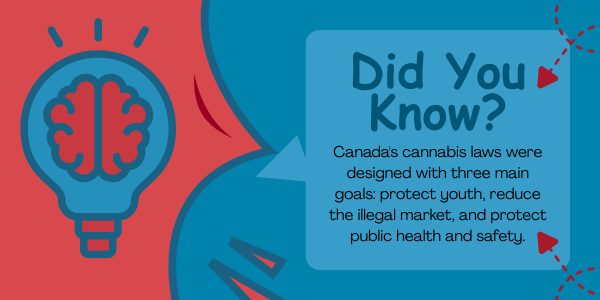
The Government of Canada regulates cannabis nationwide through the Cannabis Act, designed to keep cannabis away from youth and displace the illicit market.
Legal Classes: Production and sale are legal for dried cannabis, fresh cannabis, oils, edibles, extracts, and topicals.
Packaging Restrictions: All retail products must feature child-resistant packaging and a standardized cannabis warning symbol. Edibles are strictly limited to a maximum of 10 milligrams of THC per package to lower the risk of accidental overconsumption.
Provincial Regulations
The Government of Saskatchewan Cannabis Framework layer additional provincial restrictions on top of federal baselines:
-
Legal Age: You must be 19 years or older to buy, possess, or consume non-medicinal cannabis (matching the provincial drinking age).
-
Public Possession: Adults may carry up to 30 grams of legal, dried cannabis in public.
-
Public Use: Consuming cannabis in public spaces is illegal. Usage is prohibited on school grounds, child care facilities, and in public smoke-free zones.
-
Safe Transport: Cannabis in a vehicle must be in closed packaging and out of reach of all occupants (e.g., stored in the trunk). Consuming cannabis in a vehicle by a driver or passenger is strictly illegal.
Impaired Driving: Saskatchewan enforces a strict, zero-tolerance policy for cannabis and driving. It is illegal to operate a motor vehicle with any detectable level of THC in your system, which applies equally to recreational and medical users.
Detection & Enforcement: Police officers use roadside oral fluid (saliva) screening devices to test for recent consumption. The 12-to-24 Hour Window: Saliva tests are calibrated to detect recent use. THC typically remains detectable in oral fluids for 12 to 24 hours after consumption (and significantly longer for heavy, daily users).
For more information, you can visit the Cannabis and Driving section of the Government of Saskatchewan's website.
Police officers use roadside oral fluid (saliva) screening devices to test for recent consumption. The 12-to-24 Hour Window: Saliva tests are calibrated to detect recent use. THC typically remains detectable in oral fluids for 12 to 24 hours after consumption (and significantly longer for heavy, daily users).
Criminal Charges: If a driver is determined to be criminally impaired via a blood sample or physical evaluation, they face federal charges under the Criminal Code. A conviction results in a minimum 1-year driving prohibition, a permanent criminal record, and court-ordered fines.