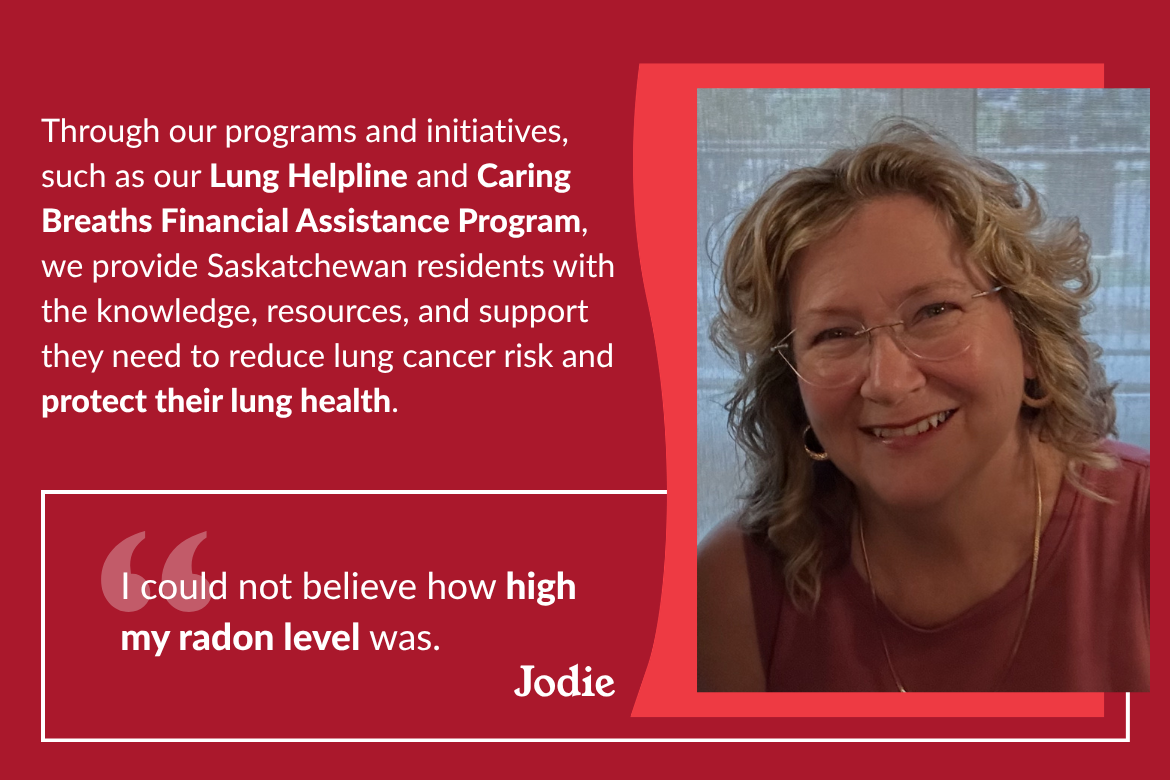
I could not believe how high my radon level was.
1,325 Bq/m³.
That was the radon level in my home when I tested in November 2025.
 I had no idea it was that high. It was disturbing to know there was a threat in my home that I could not see, touch or smell. Health Canada recommends taking action to reduce radon levels when they exceed 200 Bq/m³. My result was more than six times the guideline. Knowing that radon is the second leading cause of lung cancer, I knew I needed to take action.
I have lived in the same Regina home for most of my life. Built in 1972, it is the home where I grew up with my parents. My dad was actually the person who first told me about radon. In November 2015, he encouraged me to attend a radon information session hosted by Lung Saskatchewan. He also encouraged me to purchase a radon test kit.
I bought a radon test kit, but I did not use it right away. Life got in the way, and the test kit sat unused. Then my parents’ health began to change. In 2017, my dad was diagnosed with lung cancer. He underwent surgery to remove part of his lung, but after months of serious complications, he sadly passed away in January 2018.
Years later, in the fall of 2025, a friend loaned me a radon detector. I decided it was finally time to test. When I got the result, I was terrified. I literally could not settle or rest until the mitigation was done. Finding such a high level of radon in the home where I had lived for so many years was frightening.
I contacted Lung Saskatchewan for information and guidance on what to do next.
With their support, I decided to have my home mitigated in January 2026. Lung Saskatchewan also encouraged me to apply for its Caring Breaths Financial Assistance Program, and the grant I received helped with the financial cost of the mitigation work. Having access to that support helped me take an important step towards making my home safer.
Through your generosity, Lung Saskatchewan’s Caring Breaths Financial Assistance Program helps Saskatchewan residents facing a lung cancer or lung transplant journey, as well as those who need financial assistance for radon mitigation in their homes.
After the mitigation system was installed, I purchased a radon detector, and the mitigation company helped me set it up. I was able to watch my radon numbers steadily drop. In January 2026, my radon level was down to 79 Bq/m³, well below Health Canada’s guideline.
Taking steps to reduce my radon level and make my home safer gave me peace of mind.
I know some people may have heard about radon and moved on without testing their homes. Others may keep putting it off, as I did. It can be easy to assume your home is safe, especially if you have lived there for years without any concerns. But radon testing is not something to ignore or delay. You cannot see or smell it, and the only way to know your home’s radon level is to test and know your numbers.
My advice to anyone who is hesitant about testing their home is simple. Just do it so you can know your numbers. Peace of mind is priceless.
I am thankful to Lung Saskatchewan for the information, guidance and financial support that helped me take action and make my home safer. I hope my experience encourages others to learn about radon and take steps to make their homes safer.
Jodie

Did you know 1 in 3 homes in Saskatchewan have radon levels above Health Canada’s recommended guideline of 200 Bq/m³?
We keep track of health numbers like blood pressure and cholesterol. But there’s another important number to know: the radon level in your home.
Radon is an invisible, odourless gas and the second-leading cause of lung cancer.
Testing is the only way to know your home’s radon level. It is easy, inexpensive and can save lives.
Learn more at HomeRadonTest.ca.