
Spiriva® Respimat® inhaler
This product is manufactured by Boehringer Ingelheim using the ingredient tiotropium bromide monohydrate.
This product is inhaled into the lungs using the Respimat®.
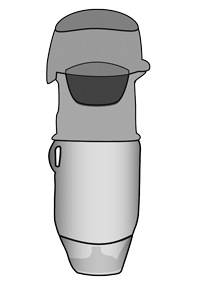
play
Respimat®
Why is it prescribed?
Spiriva® Respimat® is used as a long-acting bronchodilator for the maintenance treatment of chronic obstructive pulmonary disease (COPD) and is also used as add-on maintenance bronchodilator therapy in adult patients (18 years and older) with asthma who remain symptomatic on a combination of inhaled corticosteroid and long-acting beta2-agonist and who experienced one or more severe exacerbations in the previous year.
- Each box contains 1 Respimat® inhaler and 1 cartridge, providing 60 puffs (30 medicinal doses). Physician samples provide 28 puffs (14 medicinal doses).
- The cap of the Respimat® inhaler is colour-coded to match the cartridge.
- Never spray the medication toward the eyes
- Before the inhaler is used for the first time, the cartridge must be inserted into the inhaler and then primed.
- Prepare For First Time Use:
- Step 1. With the blue cap closed, press the safety catch while pulling off the clear base. Be careful not to touch the piercing element located inside the bottom of the clear base.
- Step 2. Insert the narrow end of the cartridge into the inhaler. Place the inhaler on a firm surface and push down firmly until it snaps into place. You should hear a “click” when it has gone in all the way.
- Step 3. Put the clear base back into place until it “clicks”. Do not remove the clear base again.
- Step 4. Keeping the cap closed, turn the clear base in the direction of the arrows on the label until it "clicks" (half a turn)
- Step 5. Open the cap until it snaps fully open.
- Step 6. Point the inhaler toward the ground. Press the dose-release button. Close the cap. Repeat steps 4 to 6 until a cloud is visible. After a cloud is visible, repeat steps 4 to 6 three more times.
- Daily Dosing:
- Step A. Hold the inhaler upright with the blue cap closed, so you do not accidentally release a dose of medicine. Turn the clear base in the direction of the black arrows on the label until it clicks (half a turn).
- Step B. Flip the blue cap until it snaps fully open.
- Step C. Breathe out slowly and fully, and then close your lips around the end of the mouthpiece without covering the air vents. While taking a slow, deep breath through your mouth, PRESS the dose-release button and continue to breathe in. Hold your breath for 10 seconds or for as long as you feel comfortable.
- To take the second puff, repeat steps A, B, and C one more time then close the cap.
- If the inhaler has not been used for more than 7 days, spray 1 puff toward the ground to prepare the inhaler for use. If it has not been used for more than 21 days, repeat Steps 4,5,and 6 above until a spray is visible.
- The dose indicator shows approximately how much medicine is left. When the pointer enters the red area of the scale, there is enough medicine for 7 days (30 dose product) or 3 days (14 dose product). This is when you need to refill your prescription.
- Once the dose indicator has reached the end of the scale, all puffs have been used and the inhaler locks automatically. At this point, the base cannot be turned any further.
- Throw away the Spiriva® Respimat® inhaler 3 months after insertion of cartridge into inhaler, even if all the medicine has not been used, or when the inhaler is locked, whichever comes first.
- Store at room temperature, between 15-30°C.
Alternatives
Other products that have the same ingredient as Spiriva® Respimat® inhaler are •Inspiolto® Respimat® inhaler •Lupin-Tiotropium inhaler •Spiriva® inhaler •
See other products used in the treatment of •bronchospasm associated with COPD •chronic bronchitis (COPD) •COPD •emphysema (COPD) •
- For the treatment of asthma and COPD, the recommended dose is 2 inhalations of 2.5 mcg once daily.
- Individuals with asthma should also be taking an inhaled corticosteroid and a long-acting beta2-agonist.
Tiotropium is a long-acting bronchodilator. It opens up narrowed breathing passages to help relieve symptoms of asthma and COPD.
Along with its needed effects, tiotropium may cause some unwanted or undesirable effects. Often, tiotropium users who use their medication properly, never experience any unwanted effects. The severity and duration of these effects are dependant on many factors including duration of therapy, dose, route of administration and individual response. Possible unwanted effects include:
- dry mouth
- chest pain
- sinusitus
- constipation
- stomach pain
Less common:
- allergic reactions
- leg pain
- tingling sensation
- increase blood glucose
- increase cholesterol levels
Rare:
- difficulty urinating
- rapid heart beat
Many of these unwanted effects, especially the most common ones, may disappear with continued use. Check with the doctor or pharmacist if any of them continue or become bothersome.
- Tiotropium is used as a once daily maintenance bronchodilator. It should not be used for acute episodes of bronchospasm. It is not a rescue medication.
- Immediate hypersensitivity reactions (e.g. skin rash, swelling of the lip, tongue and face) may occur after administration of tiotropium.
- Inhaled medicines may cause inhalation-induced bronchospasm.
- Precautions should be taken to prevent getting the drug powder in the eyes. Getting tiotropium in the eye may cause eye pain or discomfort, temporary blurring of vision, visual halos or coloured images and may cause or worsen narrow-angle glaucoma.
- Tiotropium should not be used more frequently than once daily.
- This medication should not be used in people with an allergy to tiotropium or to atropine and its derivatives (e.g. ipratropium), or to lactose.
- Tiotropium should be used with caution in people with narrow angle glaucoma, enlarged prostate, bladder obstruction, kidney disease.
Use in pregnancy: No human data available. Consult your doctor or pharmacist before use.
Use while breastfeeding: No human data available. Consult your doctor or pharmacist before use.